
MY WISHLIST
MY WISHLIST

TL;DR:
Mixing luxury brands in a smart wardrobe is defined as the deliberate pairing of pieces from different designer houses to create cohesive, versatile outfits that maximize style and cost-per-wear. This approach treats your wardrobe as a curated collection rather than a brand-by-brand accumulation. Done well, it produces more outfit combinations from fewer pieces, reduces impulse purchases, and builds a personal aesthetic that no single label can deliver alone. Brands like Saint Laurent, Valentino, and Gucci each carry distinct visual codes. Knowing how to combine them is the skill that separates a thoughtful wardrobe from an expensive closet.
The foundation of any effective multi-brand wardrobe is a luxury capsule of roughly 20–30 core pieces. According to Robb Chateau’s 2026 analysis, a capsule of 20–30 pieces provides decades of wear and genuine style versatility. That number is not arbitrary. It is the point where every item earns its place and rotation stays high, which directly lowers your cost-per-wear across the entire wardrobe.
The pieces that mix best across brands share one quality: they are defined by cut and material, not by logo. These are the items that let a Gucci accessory or a Valentino bag read as an accent rather than a billboard.
The strongest foundation pieces for a multi-brand luxury wardrobe include:
Robb Chateau’s research also highlights that timeless luxury pieces like a Loro Piana cashmere coat or a Chanel Classic Flap integrate across brands because their aesthetics are defined by quality and proportion, not seasonal trends. These pieces form the pillars of any well-mixed wardrobe.
Pro Tip: Before buying any new luxury piece, ask whether it works with at least five items you already own. If it does not, it belongs to a single-brand outfit, not a mixed wardrobe.
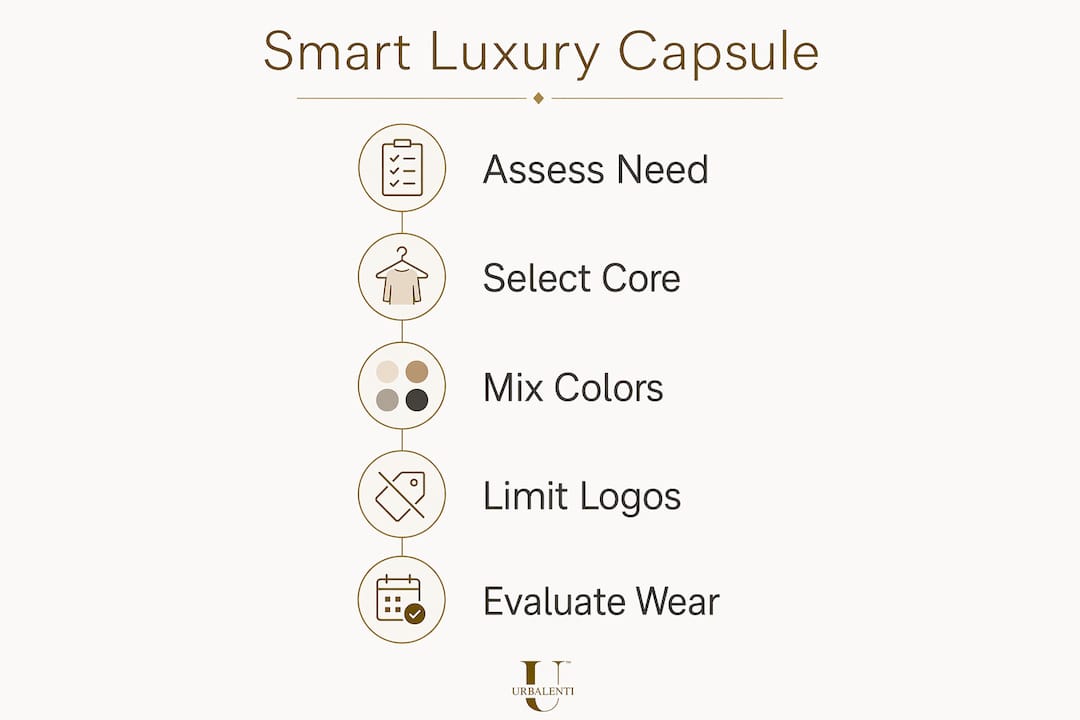
Color coordination is the first rule of effective brand mixing. Neutrals, specifically black, ivory, camel, and navy, function as connective tissue between pieces from different houses. When you build an outfit around a neutral base, a statement piece from any brand reads as intentional rather than accidental.
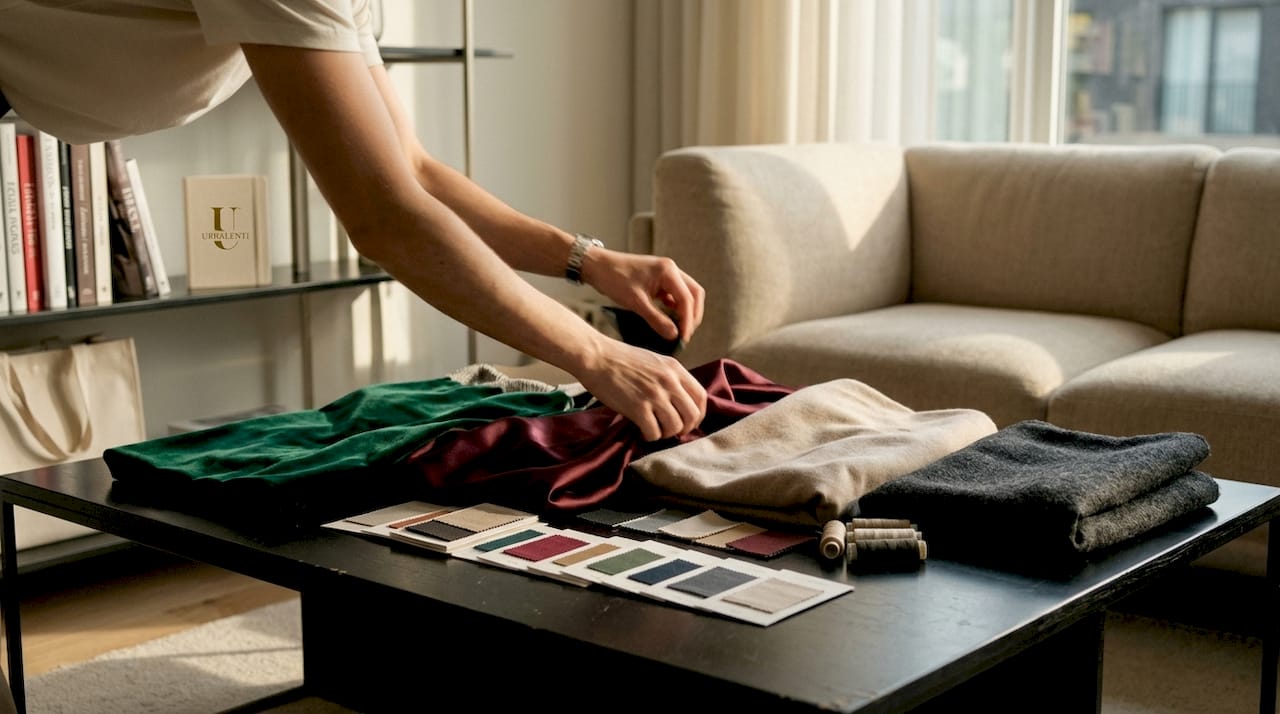
Color theory principles such as complementary and analogous palettes apply directly to multi-brand dressing. A complementary palette pairs colors opposite each other on the color wheel, creating contrast that feels deliberate. An analogous palette uses colors adjacent to each other, producing a quieter, more tonal result. Both approaches work with luxury pieces. The choice depends on whether you want the outfit to speak loudly or softly.
Pattern mixing follows a clear hierarchy. One pattern per outfit is the default. Two patterns work when one is large-scale and one is small-scale, and when they share at least one color. Three patterns rarely succeed outside of editorial contexts. Gucci’s maximalist prints, for example, work best when every other piece in the outfit is solid.
Balancing overt branding is where most people make mistakes. Fashion experts recommend pairing branded items with understated or unbranded pieces so that the logo reads as a signature rather than a statement. A Gucci bag with a visible monogram works best against a clean Saint Laurent blazer and plain trousers. Stacking a Gucci bag, a Valentino logo belt, and a branded cap in one outfit produces visual noise, not style.
Thematic grouping is an underused technique. Rather than mixing brands randomly, build outfit groups around a consistent theme: tailored minimalism, relaxed Italian luxury, or urban edge. Each theme draws from multiple brands but produces a coherent result. A tailored minimalism group might combine a Brunello Cucinelli coat, an Emporio Armani shirt, and a Bottega Veneta bag. An urban edge group might pair a Givenchy graphic piece with Golden Goose sneakers and a structured Jacquemus accessory.
Pro Tip: Lay out a full outfit before wearing it. Logo count above two in a single look is almost always too many. Remove one branded piece and replace it with something clean.
AI wardrobe tools now convert unstructured closets into virtual styling systems that reduce decision fatigue and improve outfit consistency. This is not a minor convenience. When you own pieces from six or seven different brands, the number of possible combinations exceeds what most people can hold in their heads. A digital closet solves that problem.
Wearra is an AI outfit planner for iPhone that lets you digitize your wardrobe by importing photos or brand data. Once your pieces are in the system, you tag each item by brand, color, season, and fit. The app then generates outfit combinations and packing lists based on your actual owned pieces, not generic suggestions. It also includes an AI stylist chat and a virtual try-on feature.
The practical steps for setting up a digital wardrobe for multi-brand mixing are:
Color theory tools, such as the Outfit Color Combination Generator from What Wear Under, complement AI wardrobe apps by helping you verify that a proposed combination follows sound color principles before you commit to wearing it.
| Feature Benefit for multi-brand mixing | |
| Digital closet | Centralizes pieces from all brands in one view |
| Brand and color tagging | Enables filtering by aesthetic, not just by house |
| AI outfit recommendations | Surfaces combinations you would not think of manually |
| Travel capsule planning | Reduces overpacking by maximizing outfit count per piece |
| Virtual try-on | Tests combinations without physically staging them |
Pro Tip: Tag the color of each piece as a specific tone, not just a category. “Camel” and “tan” are different colors in a mixing context. The more precise your tags, the more useful the AI recommendations become.
Cost-per-wear, or CPW, is calculated by dividing the purchase price of a piece by the number of times you wear it. The Sustainability Atlas provides a clear example: a $30 jacket worn 15 times has a CPW of $2.00, while a $120 jacket worn 200 times has a CPW of $0.60. The more expensive piece is actually cheaper per use. This is the core financial logic behind investing in fewer, better luxury items.
Mixing luxury brands amplifies this logic. When a single piece works across multiple outfit themes and brand combinations, its wear count rises faster. A Brunello Cucinelli cashmere coat that pairs with Saint Laurent, Valentino, and Emporio Armani pieces gets worn far more often than a coat that only works in one context. Higher rotation is the principal driver of lower CPW, and it outweighs brand prestige as a financial factor.
Resale value reinforces the investment case. Luxury brands retain 35–55% of retail value after two years. Fast fashion retains 8–15%. That gap means a $1,500 Saint Laurent blazer you no longer wear can return $525–$825 at resale. A $150 fast-fashion equivalent returns $12–$22. The total cost of ownership for luxury is lower than it appears at the point of purchase.
The table below contrasts two wardrobe-building approaches across the same budget:
| Factor Investment approach Accumulation approach | ||
| Piece count | 20–30 core pieces | 80–120 mixed pieces |
| Average CPW | Low, due to high rotation | High, due to low rotation per item |
| Resale value after 2 years | 35–55% of retail | 8–15% of retail |
| Brand mixing potential | High, due to neutral and versatile pieces | Low, due to trend-specific items |
| Wardrobe lifecycle | Decades | 1–3 seasons |
The cost-per-wear framework transforms luxury shopping from impulse buying into a deliberate investment strategy. Each purchase is evaluated on usefulness and rotation potential, not on novelty. That shift in thinking is what separates a smart luxury wardrobe from an expensive one.
Pro Tip: Before purchasing a new luxury piece, estimate how many times per year you will realistically wear it. Divide the price by that number and multiply by the years you expect to own it. If the CPW is under $5, the investment is sound. If it is over $20, reconsider.
Mixing luxury brands effectively requires a neutral foundation, disciplined color coordination, and a capsule of 20–30 versatile pieces that rotate frequently to lower cost-per-wear.
| Point Details | |
| Capsule size matters | A wardrobe of 20–30 core luxury pieces produces more combinations than a larger, less curated collection. |
| Neutrals unify brands | Building outfits on neutral tones lets pieces from different houses read as a single, coherent look. |
| CPW justifies luxury spend | Pieces worn 200 or more times cost far less per use than cheaper items worn rarely. |
| Tagging drives AI accuracy | Precise metadata in apps like Wearra produces better multi-brand outfit recommendations. |
| Resale value is part of the math | Luxury pieces retain 35–55% of retail value after two years, lowering total cost of ownership. |
Most people build a luxury wardrobe by brand first and outfit second. They buy a Gucci piece because they want Gucci, then try to make it work with what they already own. That sequence almost always produces a closet full of expensive items that do not talk to each other.
The approach that actually works starts with function and proportion. You identify the gaps in your outfit rotation, then find the piece that fills them, regardless of which house made it. A Saint Laurent blazer earns its place because it layers over everything. A Valentino bag earns its place because its scale and color work across three outfit themes. The brand is a byproduct of the selection, not the reason for it.
The other misconception I see often is that mixing brands requires matching aesthetics. It does not. Gucci’s maximalism and Brunello Cucinelli’s restraint can coexist in one outfit. The key is that one of them leads and the other supports. Two dominant aesthetics in a single look compete. One dominant and one supporting creates contrast that reads as intentional.
AI tools like Wearra have changed how I think about wardrobe planning. Seeing your entire inventory in one view, tagged and organized, makes the gaps obvious and the combinations visible. It removes the guesswork that leads to redundant purchases. The investment case for luxury fashion becomes much clearer when you can see exactly how many outfits each piece enables.
The most common mistake I observe is buying a statement piece without a supporting wardrobe. A Valentino couture jacket with nothing to pair it with is a costume, not a wardrobe asset. Buy the foundation first. The statement pieces will work harder for it.
— Admin Urbalenti
Urbalenti™ NYC carries the designer pieces that form the foundation of a well-mixed luxury wardrobe, sourced directly from Milan and fulfilled worldwide via DHL Express.
The current catalog includes versatile pieces from Saint Laurent, Valentino, Gucci, Givenchy, Jacquemus, Dolce & Gabbana, and Jimmy Choo, among others. Each item is authenticated and selected for its mixing potential across multiple outfit contexts. A Dolce & Gabbana Sicily handbag or a pair of Jimmy Choo Diamond Light Flex sneakers are the kind of anchor pieces that work across brands and occasions. Every client at Urbalenti™ NYC receives personalized support from selection through delivery, with no minimum purchase required for VIP-level service. Browse the full collection of designer wardrobe essentials to find pieces that integrate with what you already own.
A luxury capsule of 20–30 core pieces provides the best balance of versatility and manageability. This size allows for many outfit combinations while keeping rotation high and cost-per-wear low.
Limit visible logos to one or two per outfit. Pair a branded statement piece, such as a Gucci bag, with understated or unbranded items so the logo functions as an accent rather than the entire look.
Brands with neutral or minimalist aesthetics, such as Brunello Cucinelli, Saint Laurent, and Bottega Veneta, mix most easily. More expressive brands like Gucci or Valentino work best as a single statement piece within an otherwise restrained outfit.
Cost-per-wear is calculated by dividing a piece’s price by the number of times you wear it. Luxury pieces worn frequently across multiple brand combinations produce a lower CPW than cheaper items worn rarely, making them the more cost-effective choice over time.
Yes. Apps like Wearra digitize your wardrobe and generate outfit combinations based on your actual inventory. Precise tagging by brand, color, and season significantly improves the quality of multi-brand outfit recommendations.
Leave a comment