
MY WISHLIST
MY WISHLIST

An Italian or EU belt number is the belt’s length in centimeters, measured from the buckle fold to the center hole, not a copy of your waist size. The fastest way to find yours: add about 2 inches, roughly 5 cm, to your trouser waist as a starting point, then confirm by measuring a belt that already fits you well. A 34-inch waist typically corresponds to an Italian belt size around 90 to 95 cm.
TL;DR:
- Belt measurements should be taken from the buckle fold to the center hole for accurate sizing, not the full strap length or waist size.
- A 90 to 95 cm belt corresponds to a 34 to 36-inch waist, requiring primary reliance on the belt’s actual measured size, not the labeled number.
- Sizing up is safer than down when between two sizes, as leather belts can be shortened but not stretched over time, especially for genuine leather.
- Always measure at the center hole you use regularly, preferably at the end of the day, to account for natural waist variations and leather stretching.
- Shoes and belts sourced from Milan-based brands like Urbalenti™ NYC adhere to a standard in centimeters, simplifying cross-system comparisons without requiring unit conversion.
Three methods work, and they rank in order of reliability.
The hole you buckle to matters more than people think. Always measure to the hole you actually use day to day, not the tip of the strap and not an end hole you’ve never touched. If your number falls between two stamped sizes, it is recommended to choose the larger one. Designer leather holds its shape better when it is not stressed at the edge of its adjustment range.
Pro Tip: Measure at the end of the day when possible. Waist measurements taken first thing in the morning tend to run slightly smaller than they do after a normal day of sitting, eating, and moving around.
Common mistakes worth avoiding: measuring to the very tip of the strap instead of the center hole, including the buckle’s thickness in the number, and measuring over a thick sweater or heavy denim that adds a false inch. Each of these throws your result off in a way that only becomes obvious once the belt is on.
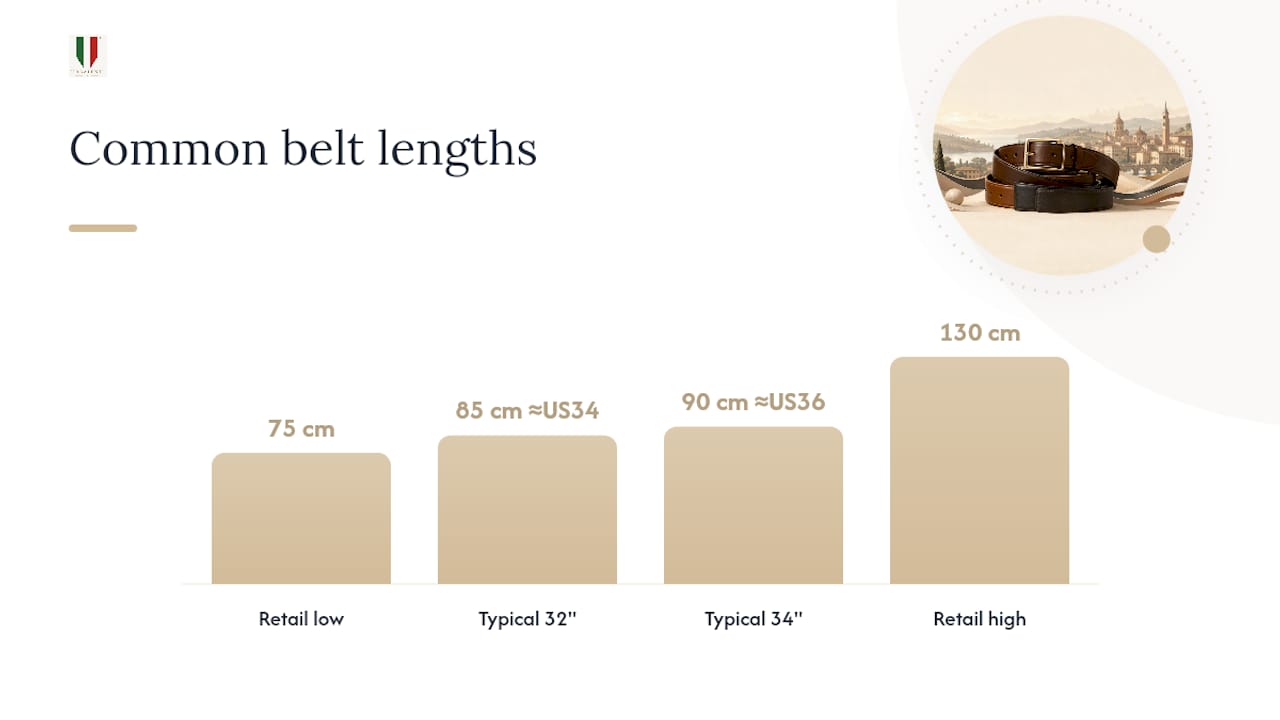
Once you have a number, whether it’s from an old belt or a fresh waist measurement, this chart maps it to the sizing language you’ll see on product pages.
A few things worth flagging about how these numbers behave in practice:
Retail charts commonly run from 75 cm up to 130 cm, covering most adult sizing without needing a custom order.
Italian and EU sizing measures the belt itself, not a promise about your body. The stamped number is the belt’s length from buckle fold to center hole, which is why a “100 cm” belt doesn’t fit a 100 cm waist. It’s built to fasten comfortably around roughly 95 cm, because the holes on either side of center give you a few centimeters of adjustment room in both directions.
Letter sizes (S, M, L, XL) show up mostly on ready-to-wear casual belts and correspond loosely to the same numeric ranges, but they’re far less precise than a centimeter measurement. If a product page offers both, trust the number.
The best fit fastens on the center hole, the third of five. This isn’t just about looking balanced. Center-hole fastening gives you room to adjust in either direction and spares the leather from the concentrated stress that causes premature creasing or stretching at an end hole.
Width matters as much as length. Check it against your trouser loops before you buy:
If a belt runs slightly long, a cobbler can trim the tip and punch a fresh hole without touching the buckle end. If it runs short, exchange it. When you’re stuck between two sizes on a leather belt you plan to keep for years, sizing up is the safer bet, since a longer strap can be shortened but a tight one can’t be stretched. Ratchet belts work differently since they adjust in fine increments rather than fixed holes, so the same base-size logic applies but with more forgiveness built in.
Pro Tip: Leather stretches slightly with wear, especially in the first few months. If a new belt feels snug at the center hole, that’s usually intentional room built in for break-in, not a sizing mistake.
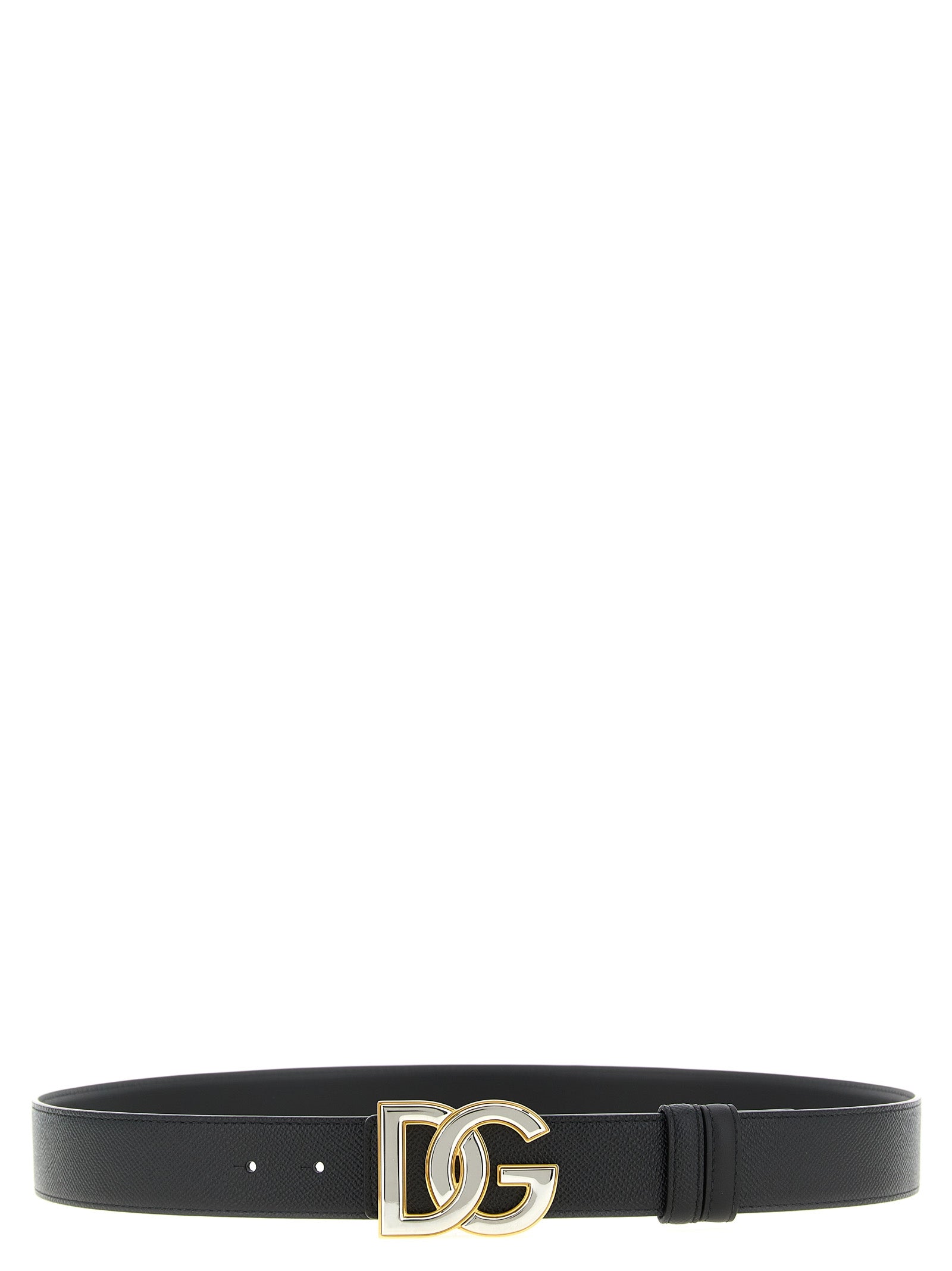
Every belt sourced through Urbalenti™ NYC’s Milan fulfillment network follows the same measurement standard covered above: length in centimeters, buckle fold to center hole. That consistency matters when you’re comparing an Italian label against a chart built around US inches.
Cheap belts forgive a bad guess. Full-grain calf leather doesn’t. A belt fastened permanently at the end hole develops a crease and loses its shape faster than one worn at center, and on a $300+ piece, that shortens its useful life by years, not months. Urbalenti™ NYC’s own advice mirrors what the industry already knows: measure an existing belt first, aim for the center hole, and size up rather than down on genuine leather. Sizing transparency on Milan-sourced product pages exists specifically so buyers don’t have to guess.
— Admin Urbalenti™ NYC
Urbalenti™ NYC lists every belt’s length in centimeters directly on its product page, measured buckle fold to center hole, the same standard covered throughout this guide. That means you can take the number from your own measurement and match it directly, no unit conversion required.
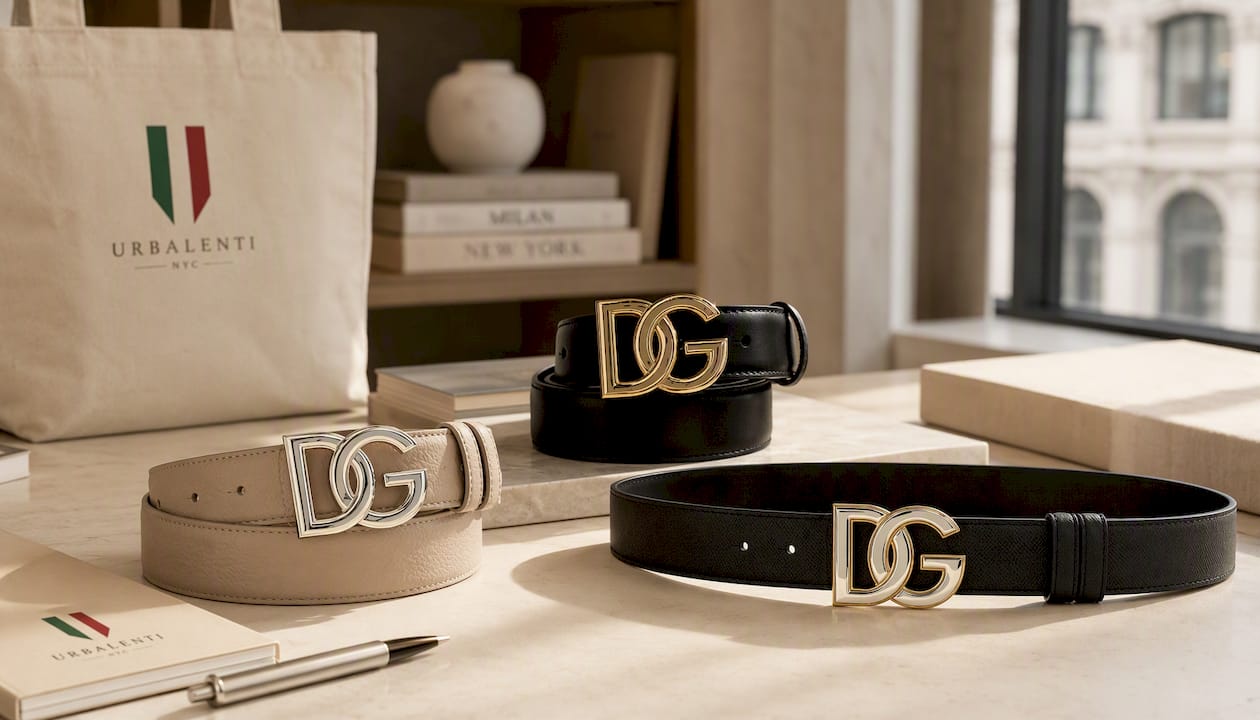
Three pieces worth checking against your measurement right now: the Dolce & Gabbana beige calf leather belt, the Dolce & Gabbana black calf leather belt, and the Dolce & Gabbana black calfskin belt, all fulfilled from Milan and shipped worldwide via DHL Express. Check the size field on the product page, cross-reference it against the conversion chart above, and if your measurement falls between two stamped sizes, reach out to Urbalenti™ NYC’s customer service before you order. Getting it right the first time means the belt fastens where it should for years, not just for the first season.
A 32-inch waist typically converts to around 85 cm on the Italian/EU scale, though it’s worth confirming by measuring an existing belt to the center hole for accuracy.
A European 34 usually refers to a 34-inch waist converted to roughly 90 to 95 cm, following the same 2-inch (5 cm) addition used across most conversion charts.
For a 32-inch waist, start around 85 cm or a US 34 belt size, then adjust up if the belt will fasten outside the center hole.
A 40/42 label covers a dual-size range, meaning the belt’s center hole is set to comfortably fit waists between roughly 40 and 42 inches, common on adjustable or two-size dress belts.
Leave a comment