
MY WISHLIST
MY WISHLIST

Yes, most goods shipped from Italy to the United States trigger customs charges. The total usually stacks a duty rate set by the item's Harmonized Tariff Schedule (HTS) code, a Merchandise Processing Fee, and sometimes a Harbor Maintenance Fee. Since July 2026, a 15% all-inclusive ceiling under the EU-US trade agreement caps most Italian-origin duty rates, though targeted tariffs on select materials still apply separately.
TL;DR:
- Most Italian goods shipped to the US are subject to duty, Merchandise Processing Fee, and sometimes Harbor Maintenance Fee, unless targeted tariffs apply.
- Duty rates are determined solely by the item's HTS code, and the 15% EU-US trade agreement ceiling limits most tariffs from July 2026 onward.
- Calculating landed costs requires identifying the correct HTS code, using the item's CIF value, and adding applicable MPF and HMF fees carefully.
- Proper documentation, including commercial invoices and accurate HTS classification, is essential for smooth customs clearance and avoiding delays.
- Using tools like tariff simulators and confirming codes before purchase can prevent surprises, especially for high-value or exotic imports.
Landed cost on an Italian shipment is rarely a single number. It's a stack of separate charges, each with its own trigger and rulebook, and understanding which ones apply to your purchase is the difference between an accurate budget and a surprise bill at delivery.
The base charge is duty, calculated as a percentage of the item's value using its HTS classification. Every product entering the US gets sorted into a 10-digit HTS code, and that code, not the item's price tag or brand name, determines the rate. A leather handbag and a leather belt can carry different duty rates even from the same shipment. CBP's guidance explains how duty determination works and which categories carry special treatment, including certain agricultural goods, alcohol, and tobacco.
Then comes the Merchandise Processing Fee. Formal entries (generally shipments valued over $2,500) pay an ad valorem MPF with a statutory minimum and cap, while informal entries below that threshold pay a flat, lower amount. The DHL import duties guide breaks down how carriers calculate this fee and when formal entry procedures kick in. Ocean shipments also carry a Harbor Maintenance Fee, though most fashion and luxury goods from Italy travel by air, which skips HMF entirely.
Section 232 tariffs on steel and aluminum content, and Section 301 tariffs tied to specific trade disputes, sit outside the standard duty calculation and apply regardless of the EU ceiling. Most apparel, footwear, and leather goods from Italy fall outside these targeted programs, but jewelry with certain metal components or hardware-heavy accessories can occasionally get caught.
| Fee Component | Applies To | Typical Basis |
|---|---|---|
| Tariff/duty | Nearly all imports above de minimis | Percentage of value, by HTS code |
| Merchandise Processing Fee | Formal and informal entries | Ad valorem (formal) or flat rate (informal) |
| Harbor Maintenance Fee | Ocean freight only | Percentage of cargo value |
| Section 232/301 surcharges | Specific materials or trade categories | Additional percentage, separate from base duty |
Calculating your actual cost requires a few sequential steps. Skip one and your estimate will be off, sometimes by a wide margin.
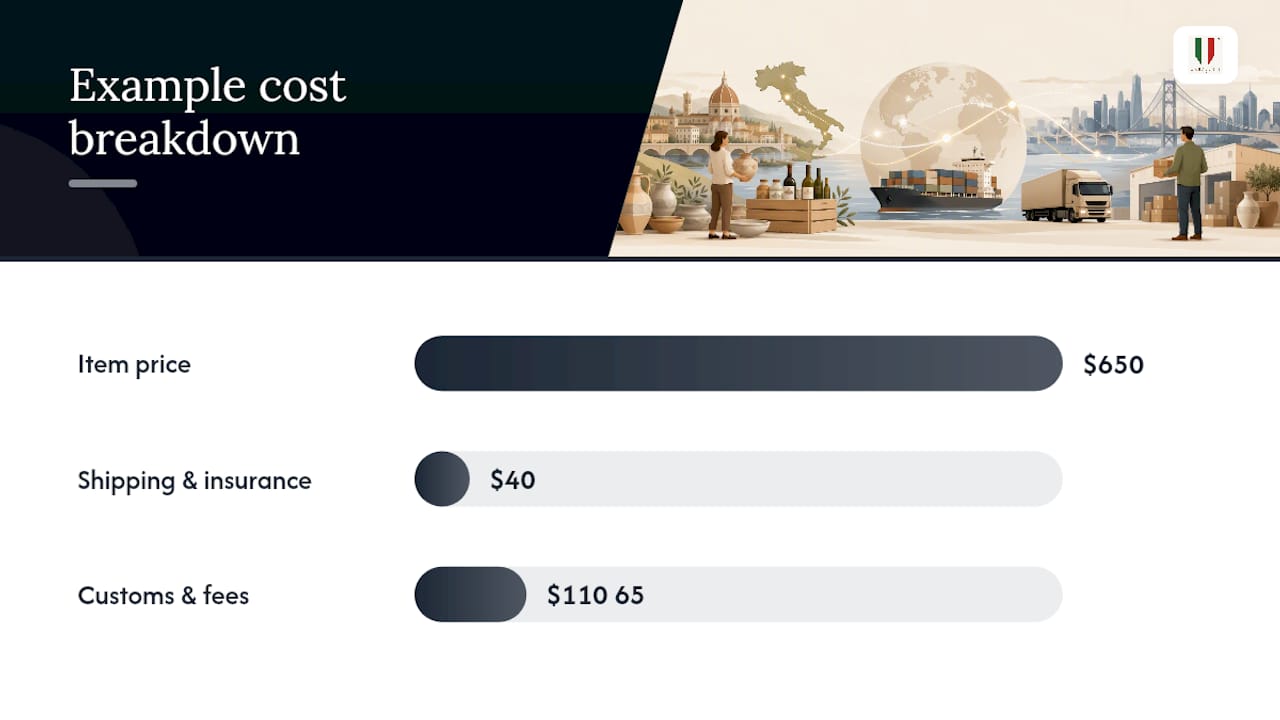
Here's the math on a real example. Say you're buying the Moncler Multicolor Polyethylene Athletic Sneakers at $650, with $40 in shipping and insurance. CIF value comes to $690. Add a formal-entry MPF (a small percentage of value, subject to the statutory floor), and total fees land in the ballpark of $110 to $115 on top of the item price.
Pro Tip: Always calculate CIF using the exact insurance and freight charges shown on your commercial invoice, not an estimate. Customs can reassess value if the declared figure looks understated relative to the shipping method used.
For anything valued near or above the formal entry threshold, or for shipments involving unusual materials (exotic leather, mixed textiles, certain metals), a licensed customs broker earns their fee. Ask a broker three things before hiring one: which HTS code they'd assign and why, whether your shipment qualifies for informal entry, and what their total fee covers versus what CBP charges separately.
Nobody wants to discover the real cost of an item after it's already shipped. A few resources let you check before you buy, though each has real limits worth knowing.
Pro Tip: Run your item through a tariff simulator first for a ballpark figure, then confirm the HTS code and rate directly on the USITC schedule before you commit to a purchase. The ten minutes it takes can save you from an unpleasant surprise at delivery.
Simulators are built for speed, not precision. Treat their output as a planning number, then verify against the official HTS entry and, if the retailer offers one, a carrier's actual landed-cost quote at checkout.
Clearance friction almost always traces back to missing or inconsistent paperwork, not the duty calculation itself. A tidy shipment moves through customs in a day or two; a messy one can sit for a week.
Choosing between DDP (Delivered Duty Paid) and DAP (Delivered at Place) shipping terms matters here too. DDP means duties are calculated and paid before the item leaves Italy, so nothing is owed on arrival. DAP means you settle duties and fees when the shipment reaches you, which can mean an unexpected charge from the carrier at delivery.
Urbalenti™ NYC fulfills every order from Milan and ships via DHL Express, which means your item travels through the same carrier network referenced throughout this guide. Checkout displays duties-paid options so US customers see the full landed cost, tariff, MPF, and shipping, before completing an order, not after.

Every shipment leaves with an accurate commercial invoice and correct HTS classification attached, which is the single biggest factor in avoiding clearance delays or reassessed duty. That attention to documentation reflects Urbalenti™ NYC's approach to shipping designer fashion from Italy, where transparency at checkout replaces guesswork after the fact.
Admin Urbalenti™ NYC
Quotas matter far less for designer fashion than most shoppers assume, but they aren't zero. The US maintains tariff-rate quotas on certain categories, mostly agricultural products and some textile fibers, where a lower duty rate applies up to a volume threshold, after which a higher rate kicks in for the rest of the year. Wool and specific fiber blends have occasionally been subject to these mechanisms historically, though enforcement on individual consumer shipments is rare compared to bulk commercial imports.
Seasonal restrictions are more of a concern for specific product types than general apparel. Items containing certain animal-derived materials, exotic leathers, or fur can face additional scrutiny or documentation requirements tied to wildlife trade regulations, separate from any tariff quota. A python-embossed leather bag, for instance, might need additional certification that a standard calfskin item wouldn't.
For the vast majority of ready-to-wear clothing, sneakers, and standard leather accessories from Italy, quotas simply don't factor into the calculation. The duty rate and MPF discussed earlier cover nearly every transaction a typical shopper will make. If you're buying something unusual, exotic skins, vintage pieces with uncertain material composition, or bulk quantities for resale, that's when it's worth asking the retailer directly whether any special import category applies before you order.
Most advice on this topic treats customs fees like a mystery tax that appears at the door. It isn't. Every component, duty, MPF, and the 15% EU ceiling, is public, calculable, and knowable before you click "buy." The conventional wisdom that you "just have to wait and see" is outdated advice built for a pre-simulator era.
What the math actually shows is that HTS classification carries more weight than shoppers realize. Two nearly identical bags can carry different duty rates purely because of stitching material or hardware composition. That's the detail worth checking first, not the exchange rate or the shipping speed.
If you take one thing from this guide, let it be this: verify the HTS code and rate before you buy, not after. A five minute lookup on the USITC schedule beats a frustrated call to a carrier after your package is stuck in a bonded warehouse.
— Admin Urbalenti™ NYC
Urbalenti™ NYC removes the landed-cost guesswork that comes with buying designer goods internationally. Where DAP shipping leaves you settling duties with a carrier at your doorstep, Urbalenti™ NYC's duties-paid checkout option shows your full cost, item price, duty, and fees, before you confirm the order.
That transparency shows up across the catalog. The Brunello Cucinelli Gray Calf Leather accessory and the Prada Black Polyamide accessory both display final landed pricing at checkout, so the number you see is the number you pay. Combined with Milan fulfillment and fast DHL Express delivery, there's no separate customs bill waiting for you after the package arrives. Browse the current collection and check out with duties handled upfront, exactly as this guide recommends.
Most purchases above the de minimis threshold incur duty, MPF, and possibly other fees. Small-value items may qualify for informal entry with reduced or no duty, though carrier handling fees can still apply.
Rates depend on the item's HTS classification, but most Italian-origin goods now fall under a 15% all-inclusive ceiling established by the EU-US trade agreement, unless a targeted tariff like Section 232 applies separately.
Find the HTS code on the USITC schedule, calculate CIF value (cost plus insurance and freight), apply the duty rate, then add MPF and HMF where applicable.
Shipments below the informal entry threshold often avoid formal duty assessment, though DHL's guidance notes that state sales tax and carrier fees can still apply regardless of duty status.
Leave a comment